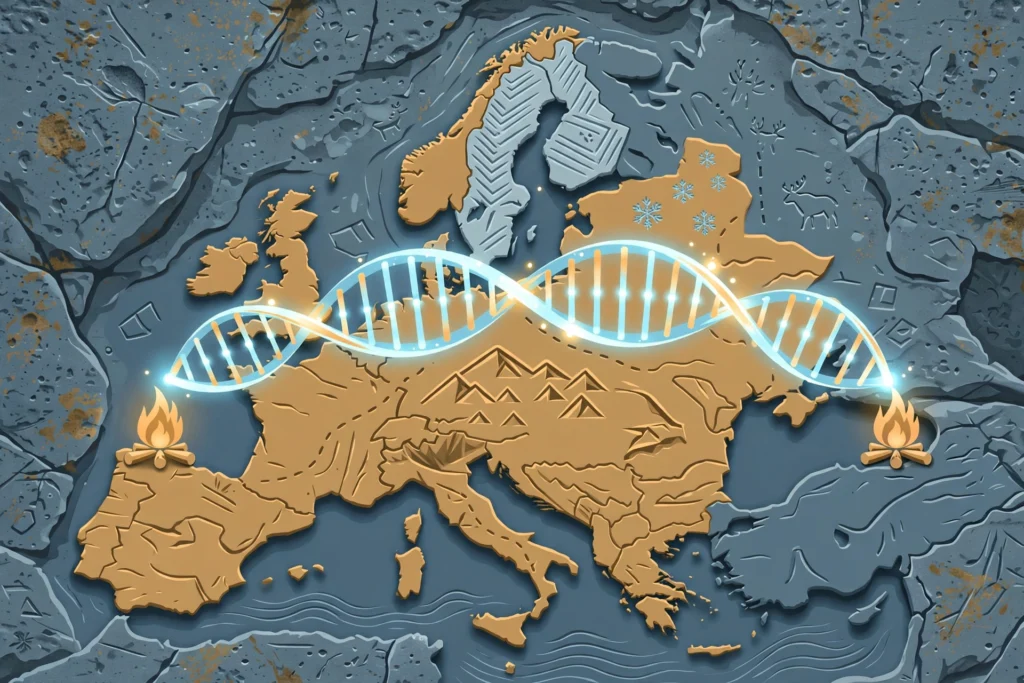
A woman who lived in a cave in southwestern France about 30,000 years ago is changing what scientists believe about Ice Age Europe. Researchers sequencing her genome recovered the oldest complete genetic data from a modern human in southwestern Europe, and it carries ancestry from both the western and the far eastern parts of the continent.
Genetic modelling dates that east-to-west gene flow to roughly 32,500 to 31,500 years ago, according to the study, published in Science Advances. “Our results show that eastern and western European populations were not as genetically isolated as previously assumed,” lead author Pere Gelabert of the University of Vienna said.
The woman belonged to the Gravettian culture, hunter-gatherers known for carving Venus figurines from mammoth ivory who ranged across Europe roughly 33,000 to 22,000 years ago. Her mostly western-European ancestry was mixed with a signal from central and eastern Europe, and a similar pattern turned up in a previously studied individual from Ormesson, France.
The team combined new and previously published genomic data with human DNA extracted from cave sediment. The researchers say the evidence, together with archaeology, supports the idea that Isturitz Cave served as a meeting place for far-flung groups.
Source: Phys.org