A European orbiter has picked up traces of hydrogen chloride gas above fissures on Alba Mons, the widest volcano on Mars, in the strongest sign yet that the planet is not geologically dead.
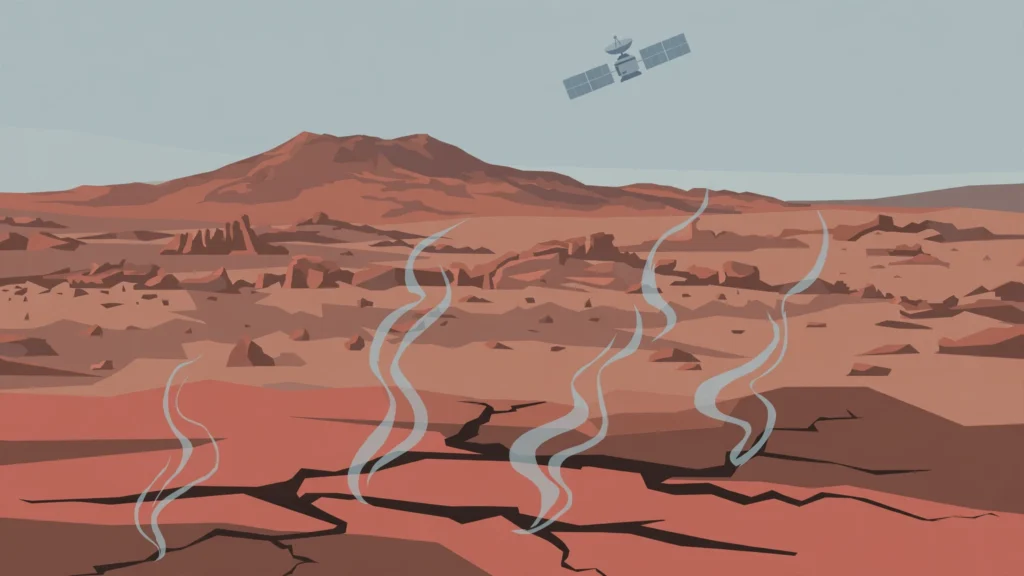
The ExoMars Trace Gas Orbiter, a joint European Space Agency and Roscosmos mission, found the gas in the low atmosphere over the volcano’s northern flank, according to a study published in the journal Science Advances.
Hydrogen chloride is a common ingredient in volcanic emissions on Earth. The researchers said volcanic seepage from a dormant magma chamber below the surface is the most likely source.
“Our findings suggest that Mars has retained enough internal heat to support volcanic activity until recently, and possibly still does,” said Daniel Mège, a planetary scientist at the Space Research Centre of the Polish Academy of Sciences and a co-lead author of the study.
The orbiter first detected hydrogen chloride in the Martian atmosphere in 2021. Since then it has recorded annual spikes of the gas along the northern flank of Alba Mons in the early Martian summer.
The team traced the gas to a series of fissures, each around 330 feet long, on the volcano’s slopes. They believe the cracks connect to sheets of molten rock below.
The evidence is not conclusive. No lava flow or eruption has ever been seen on Mars, and the researchers said the gas could have another source.
If the reading holds, it would mean Mars still has enough heat inside to drive volcanic processes, with implications for whether conditions below the surface could support microbial life, Reuters reported.
Alba Mons covers an area roughly the size of the contiguous United States, according to National Geographic. Mars hosts the largest volcanoes in the solar system, and some appear to have been active within the last few million years.
Source: Reuters