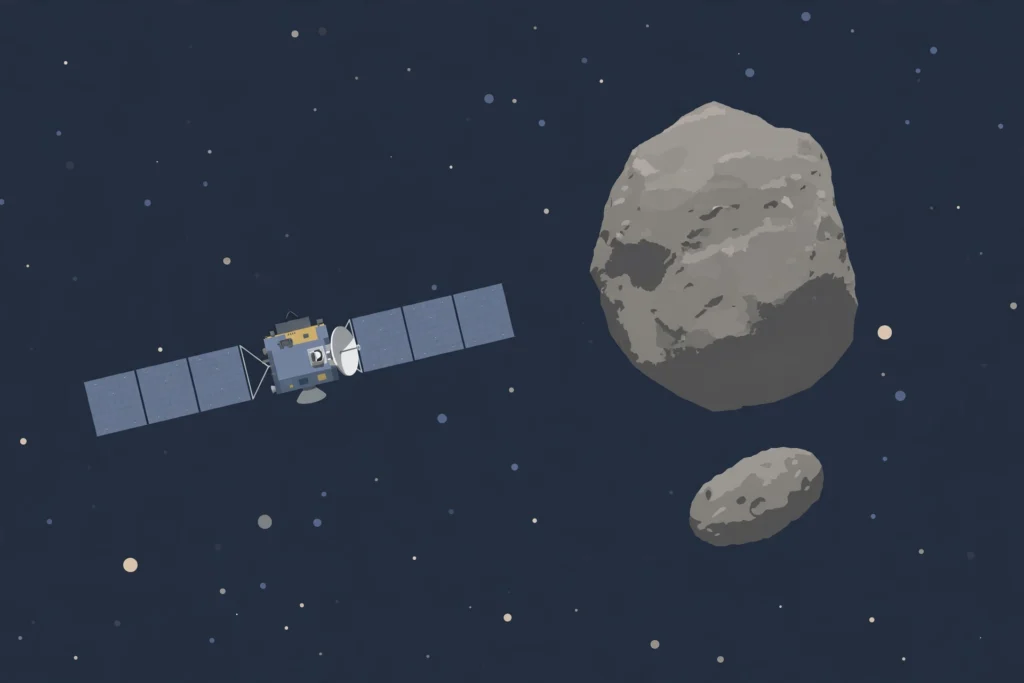
Europe’s Hera spacecraft has photographed the asteroid Didymos and its small moon Dimorphos as two separate objects for the first time. The European Space Agency announced the image on October 27, four years after NASA’s DART spacecraft deliberately crashed into Dimorphos to test whether a spacecraft impact can shift an asteroid’s path.
Hera took the picture on October 18 from about 1,280 kilometres away, with the pair sitting roughly 197 million kilometres from Earth. Dimorphos covers only about one pixel in the frame, but it is clearly separated from its parent body. “With this image, the smaller Dimorphos asteroid becomes visible for the first time,” said Michael Kueppers, Hera project scientist at the European Space Agency.
Hera launched in October 2024 and spent much of October shedding speed to match the asteroid pair. Two braking burns a week apart slowed the spacecraft to 20 metres per second relative to the asteroids. The first close approach manoeuvre was scheduled for November 4, and ESA plans to release the first detailed images of Dimorphos on November 25.
The mission is a follow-up to NASA’s Double Asteroid Redirection Test. DART struck Dimorphos on September 26, 2022, at about 6.1 kilometres per second, cutting the moonlet’s orbit around Didymos from 11 hours and 55 minutes to 11 hours and 23 minutes. Hera will now measure the mass of Dimorphos, map the impact site and survey both bodies with its cameras and two shoebox-sized CubeSats, Milani and Juventas.
Didymos measures about 780 metres across. Dimorphos, about 151 metres wide, is roughly the size of a large stadium. “For the first time we are seeing through Hera’s own eyes the very double asteroid system that the mission was designed and built for,” said mission manager Ian Carnelli.
Source: Space.com