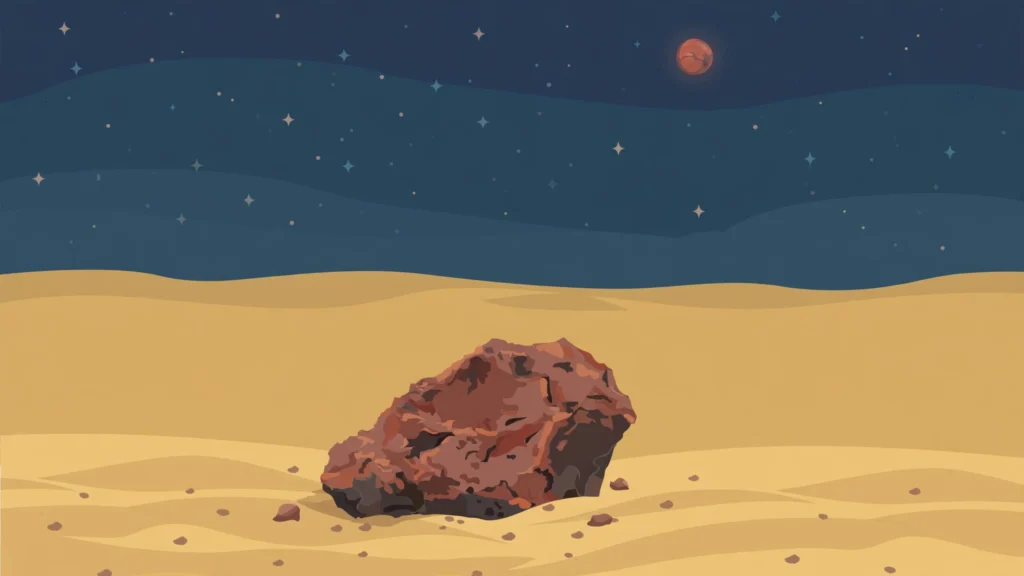
A meteorite found in the Sahara desert in 2022 formed in the crust of Mars at least 4.1 billion years ago, according to scientists. The reddish rock, named Teghaza 001, may be the oldest of the 435 known Martian meteorites on Earth.
Researchers found the meteorite in eight pieces in Mali, about 34 kilometres from the village of Bir Chali. The largest chunk is about the size of a fist. Its main minerals are feldspar and pyroxene, and it contains zircon crystals carrying uranium, which let the team date it by measuring uranium decaying into lead over time.
The rock is a coarse-grained type called gabbro. Its chemistry shows it interacted with water while it slowly cooled and crystallised beneath the Martian surface. Isotopes in the rock point to water percolating into the deeper crust and mixing with molten rock from the mantle, much as happens on Earth.
Yang Liu of NASA’s Jet Propulsion Laboratory led the study, published in the journal Science. Liu said Martian meteorites are the only samples from Mars available for laboratory study, and they form the basis for understanding how early Mars formed and whether it could have supported habitable conditions.
Only three Martian meteorites date to the planet’s early history. One, found in Antarctica in 1984, was first assessed at about 4.5 billion years old and later revised to a similar age to Teghaza 001. The new study puts Teghaza 001 as likely the older of the two.
Source: Reuters