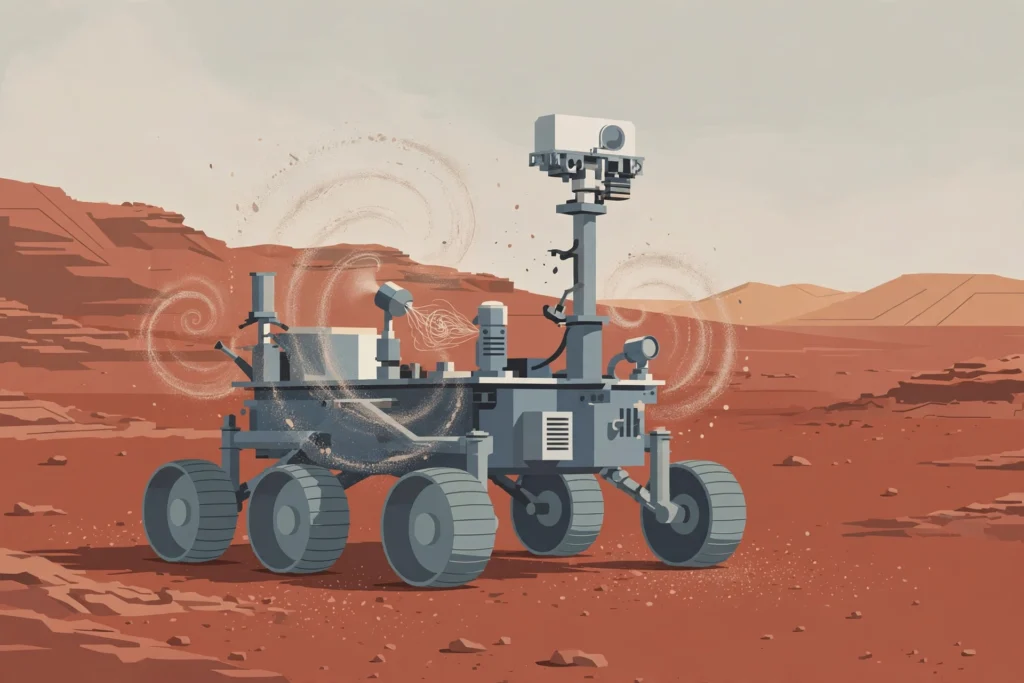
NASA’s Perseverance rover has detected the finest dust particles ever measured on Mars, according to a study published in the journal Proceedings of the National Academy of Sciences. The rover documented ultrafine particles around 100 nanometers wide, about 500 times thinner than a human hair.
Perseverance has operated in and around Jezero Crater in the Martian northern hemisphere since landing in 2021. Its Planetary Instrument for X-ray Lithochemistry, known as PIXL, recorded two categories of particles smaller than earlier instruments could resolve. Previous measurements had resolved Martian dust down to about 3 micrometers in diameter. Alongside the ultrafine grains, PIXL found a category of fine particles under 2.5 micrometers, about 30 times thinner than a strand of hair.

The findings matter for any future human mission to Mars. Dust circulates through everyday winds, dust devils and larger storms, and it must be dealt with by crews and equipment alike. Lead author Scott VanBommel, a planetary scientist at Washington University in St. Louis and a member of the Perseverance science team, said smaller particles have a higher potential to penetrate deeper into the human body and are harder for the body to clear.
Martian dust contains silica, iron compounds and chlorine compounds such as perchlorate, which are known to be harmful at high enough doses on Earth, VanBommel said. He added that toxicity depends on dose and duration, and that a smaller particle size does not necessarily make dust more dangerous.
Perseverance measured dust particles that stuck to rover hardware, including spacesuit materials carried aboard the six-wheeled vehicle to test how they hold up in the planet’s harsh environment.
Source: Reuters