Physicists have used a half-built neutrino telescope sitting 1.5 miles beneath the Mediterranean Sea to test one of the core rules behind Einstein’s theory of relativity, and found no sign that it breaks.
The international KM3NeT collaboration analysed 5,828 atmospheric neutrino events recorded by its ORCA detector off the French coast. The results were published on 4 November in the Journal of Cosmology and Astroparticle Physics.
The team tested Lorentz invariance, the principle that the laws of physics stay the same no matter which direction an experiment faces or how fast it moves. Einstein’s relativity rests on it, and some theories that try to reconcile gravity with quantum physics suggest it might fail at very small scales.
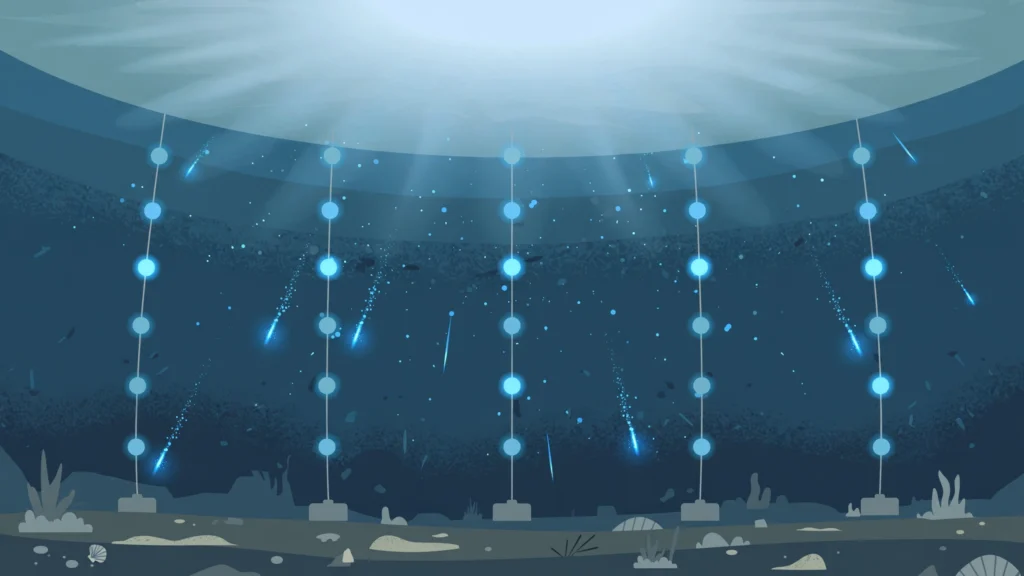
The detector works by watching for the faint flashes neutrinos make when they collide with matter in the sea. ORCA’s vertical strings of light sensors, anchored to the seafloor, record each flash and reveal the particle’s energy and direction.
The analysis used 1.4 years of data, collected between January 2020 and November 2021, when only six of the detector’s planned 100-plus sensor strings were installed. Even so, the limits it set on possible violations were competitive with those from long-running experiments such as Super-Kamiokande in Japan and IceCube at the South Pole, according to the researchers.
The study also set the first direct constraints on certain possible differences in how muon and tau neutrinos behave. The collaboration now hopes to run similar tests with KM3NeT/ARCA, a sister detector off Sicily built for higher-energy neutrinos from deep space.
Source: Phys.org