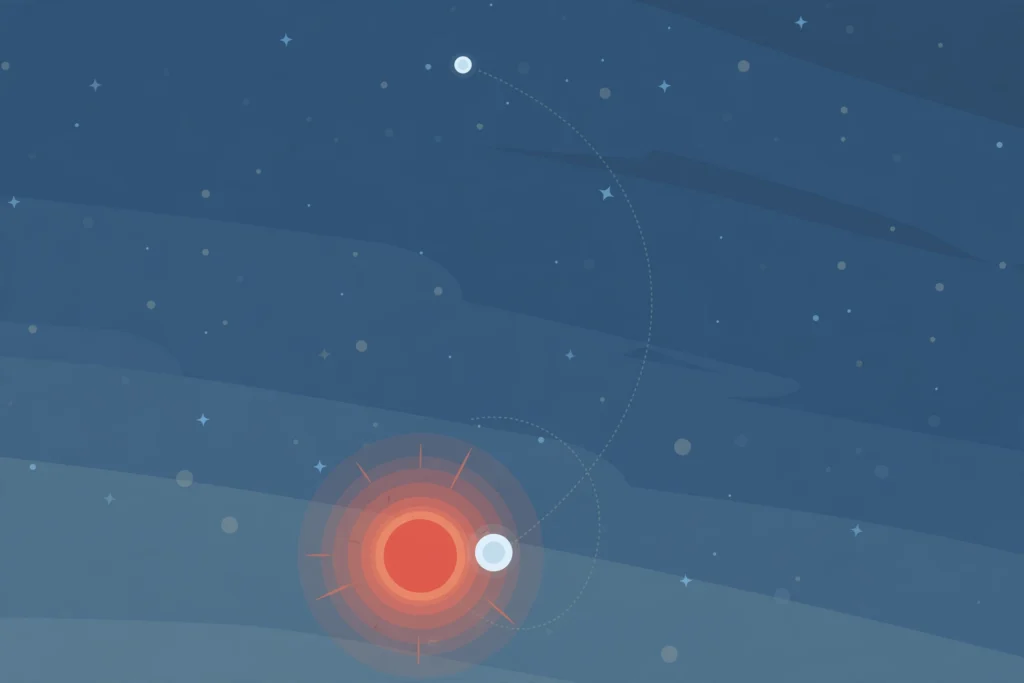
Astronomers have found a triple-star system just 28 light-years from Earth that defies the usual rules of how stars live and die.
The system, named Welopōʻai, holds a red dwarf and two white dwarfs. Researchers say it is the closest known triple-star system containing two white dwarfs, and no comparable system exists within 100 light-years of Earth.

An international team led by the Trottier Institute for Research on Exoplanets at Université de Montréal made the discovery while hunting for planets. The team published its findings in the journal Astronomy & Astrophysics on November 19.
The search started with the SPIRou instrument at the Canada-France-Hawaii Telescope on Maunakea, Hawaii. One red dwarf moved far more than expected, with velocity shifts of nearly 16 kilometres per second, more than 1,000 times the size the team was looking for.
Follow-up images from the Gemini North telescope, also on Maunakea, revealed the cause: a faint white dwarf orbiting close to the red dwarf. A second white dwarf, already known to astronomers, circles the pair from much farther out.
The red dwarf and its inner white dwarf companion circle each other every 9.83 years at a distance of about 4.6 astronomical units, a little less than Jupiter’s distance from the Sun. The white dwarf carries about 0.62 times the mass of the Sun, the red dwarf about 0.42.
What puzzles the researchers is how the red dwarf survived. When its companion swelled into a giant star near the end of its life, it should have engulfed the smaller star or pulled the two together. Instead the red dwarf sits in a wide, stable orbit. “This system should not exist,” said Patrick Dufour, a professor at Université de Montréal and a co-author of the study.
The name Welopōʻai comes from a Hawaiian naming program, A Hua He Inoa. It combines welo, meaning a family trait, with po’ai, meaning an orbit or circular path.
Source: Phys.org