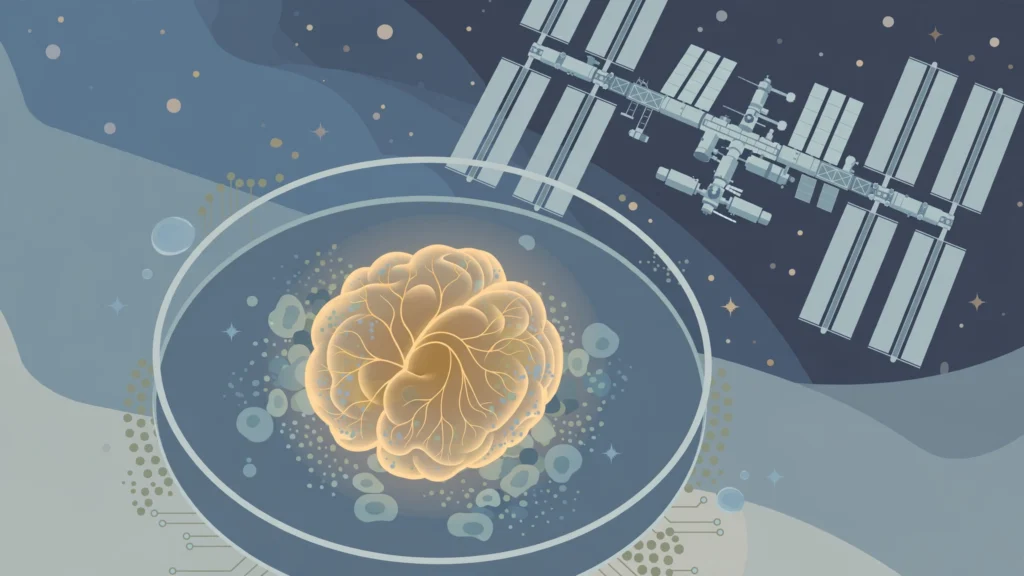
Miniature lab-grown brains sent to the International Space Station have shown that Alzheimer’s disease can develop differently depending on a person’s genes.
Researchers at the University of California San Diego grew brain organoids, small three-dimensional models of human brain tissue made from stem cells. Some carried mutations in the APP, PSEN1 or PSEN2 genes, which are linked to rare inherited forms of Alzheimer’s. Others served as controls.
In March 2024 the organoids travelled to the space station, where they spent 40 days before returning to Earth. Matching organoids stayed on the ground under near-identical laboratory conditions. The team says these were the first human brain organoids modelling Alzheimer’s to travel to space.
The results, published on November 25 in the journal Science Advances, were far from uniform. Organoids with an APP mutation produced more amyloid-beta 42, a protein fragment that clumps into plaques in Alzheimer’s brains. Those with a PSEN2 mutation showed higher levels of a disease-linked modified form of tau. Organoids with a PSEN1 mutation showed the widest changes in gene activity: 7,404 genes differed between the space-flown and ground samples, against 643 in the PSEN2 models.
One protein stood out across all groups. CIRBP, which helps cells respond to environmental and physical stress, rose after spaceflight. The researchers say it could be a candidate for further study as a shared stress marker, though whether the rise protects cells or signals damage is not yet established.
“We often talk about Alzheimer’s as though it follows one predictable path,” said Alysson R. Muotri, the study’s senior author and a professor at UC San Diego School of Medicine. He added that understanding the differences between genetic forms could lead to more targeted treatments.
The researchers stress that the findings are preliminary. The work is a cell-culture study, not evidence about patients or astronauts, and it tested no drugs. The team now hopes to learn whether the changes seen in space can be reproduced on Earth.
Source: UC San Diego