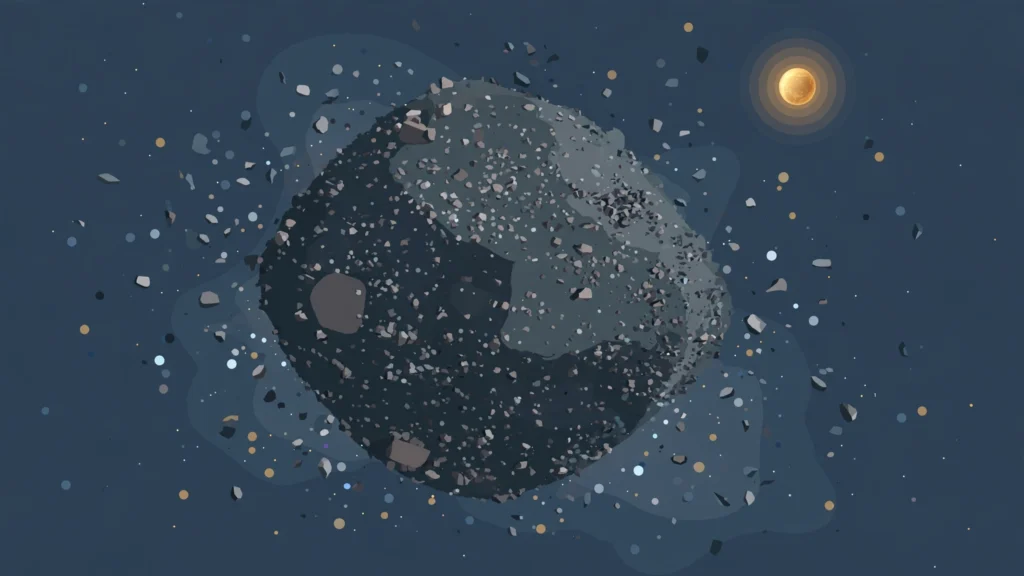
Samples from asteroid Bennu have revealed where the ancient space rock really came from, and the answer rewrites part of the story of how the solar system formed. Researchers at ETH Zurich, led by Professor Maria Schönbächler, analysed isotopes of iron, titanium and chromium in the material and published their findings in the journal Science Advances.
The analysis shows Bennu shares a distinctive chemical fingerprint with asteroid Ryugu and a rare group of primitive meteorites known as CI meteorites. That kinship suggests all three formed from the same reservoir of ancient cosmic dust, rather than from separate corners of the early solar system.
Earlier theories held that primitive asteroids like Bennu formed in the outer solar system. The new work points instead to the water-ice line, a boundary in the young sun’s disk where water vapour could freeze into ice. Dust from the inner and outer regions mixed there, and water ice helped the particles stick together into larger bodies.
Jupiter played a central role in that mixing, the researchers propose. The gas giant formed within about one million years of the sun’s birth, and its growing gravity acted as a barrier that stopped larger particles crossing its orbit while letting fine dust circulate and blend near the water-ice line. The result, Schönbächler said, is that Bennu is a hybrid, matching neither the inner nor the outer solar system cleanly.
NASA’s OSIRIS-REx spacecraft collected about 120 grams of material from Bennu and delivered it to Earth in September 2023, landing in the Utah desert. The sample is among the most primitive material ever studied, dating back some 4.5 billion years, and the researchers say it offers one of the best surviving records of the chemical mix from which the planets formed.

Source: Science Daily