
A small rocky body drifting near Earth is accelerating in a way gravity alone cannot explain, and a new study has just knocked out the leading explanation for why.
The object, known as 1998 KY26, measures about 36 feet (11 metres) across. Astronomers first spotted it in 1998, when Tom Gehrels of the University of Arizona logged it as an ordinary near-Earth asteroid. Its path has refused to behave like one ever since.
Scientists call the odd motion non-gravitational acceleration. The favoured explanation was that KY26 is a “dark comet”, a rocky body with buried water ice that turns to gas and pushes it along, without the visible tail of a normal comet.
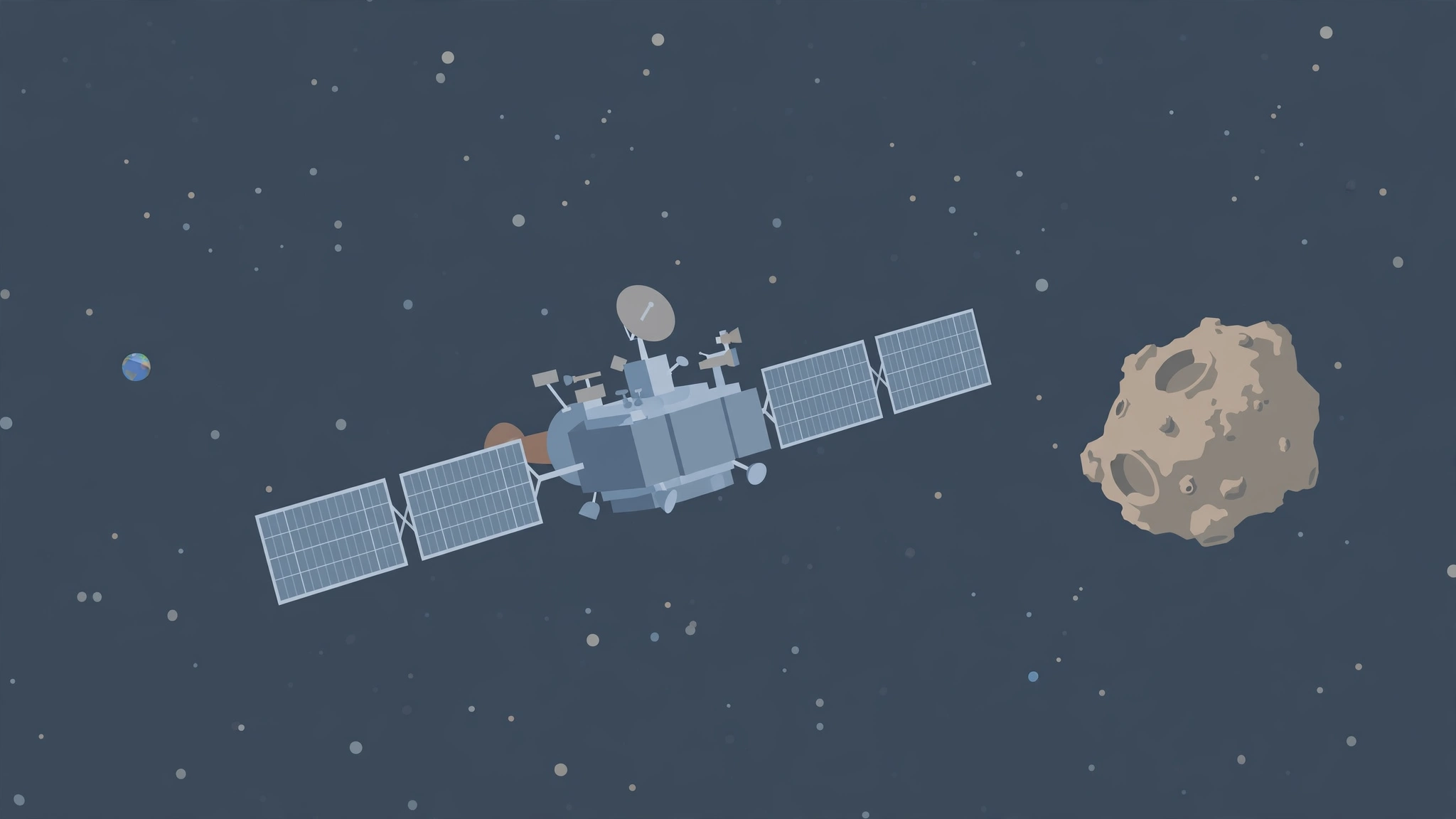
A new paper in the journal Icarus challenges that idea. Researchers at the Georgia Institute of Technology calculated that the object averages minus 53 degrees Fahrenheit, far too warm for buried ice to survive long enough to drive the motion. Darryl Z. Seligman, an assistant professor of physics and astronomy at Michigan State University who had backed the dark comet theory, put it plainly: “If something has ice, then it’s a comet. The surface of KY26 is too warm.”
Harvard astrophysicist Avi Loeb has offered a different theory. He and two colleagues argue KY26 could be Phobos 1, an uncrewed Soviet spacecraft that lost contact on its way to Mars in 1988. Loeb concedes the idea is unproven.
NASA Administrator Jared Isaacman pushed back on television on 12 November, saying he had seen no evidence the object was anything other than an asteroid. He stressed it posed no known threat to Earth.
The object also spins fast, completing one rotation every 5.35 minutes. A closer look may come in July 2031, when Japan’s Hayabusa2 spacecraft is due to rendezvous with it.
Source: The New York Times