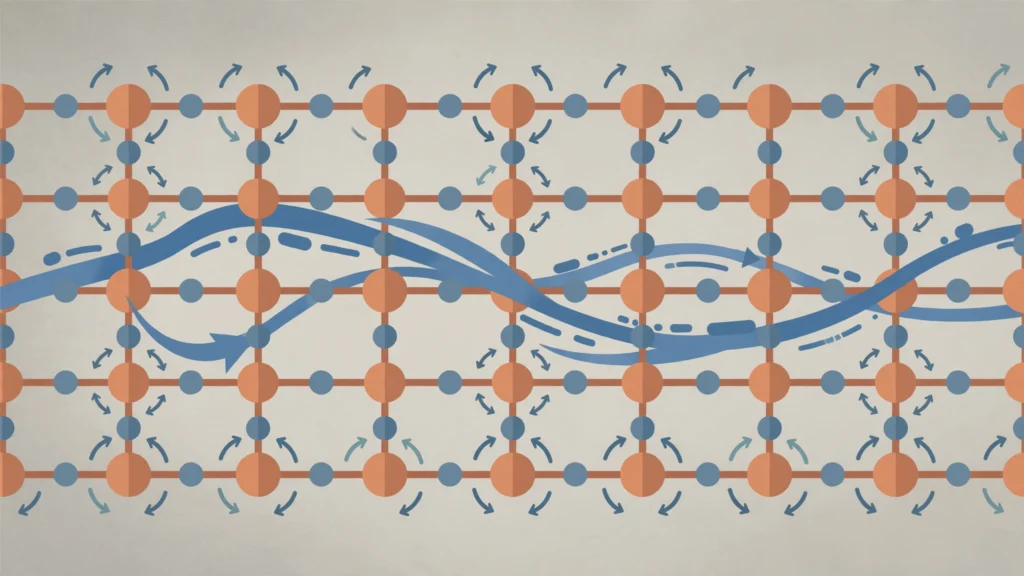
Physicists have found what they call a “smoking gun” for one of the oldest puzzles in materials science: how certain copper-oxide materials conduct electricity with zero resistance at relatively high temperatures.
A team led by the University of Bristol built a custom thin-film sample of lanthanum cerium copper oxide and tested it inside high-powered magnets at the European Magnetic Field Laboratory in the Netherlands. The data showed that conduction electrons pair up by interacting with spin fluctuations, the tiny shifting magnetic fields carried by the electrons themselves, confirming a suspicion theorists have held for decades.
“Through measurements carried out at the European Magnetic Field Laboratory in the Netherlands and subsequent careful analysis, we have found the smoking gun which solves part of the equation and explains what causes this perplexing state,” said study co-lead author Nigel Hussey, a physics professor at Bristol.
Conventional low-temperature superconductors are explained by vibrations in the material’s crystal lattice. The new study, published this week in Nature Physics, points to a different mechanism for electron-doped cuprates. Lead experimentalist Caitlin Duffy, a postdoctoral researcher at France’s National Centre for Scientific Research, said analytical techniques applied to the high-field data isolated spin-fluctuation scattering as the dominant source of resistance, and its link to the critical temperature closed the logical loop.
The researchers caution that the result covers only one side of the puzzle. Electron- and hole-doped cuprates behave differently, and the highest transition temperatures appear only on the hole-doped side, so theorists still need a fuller account before the mechanism is fully assembled.
Source: Phys.org