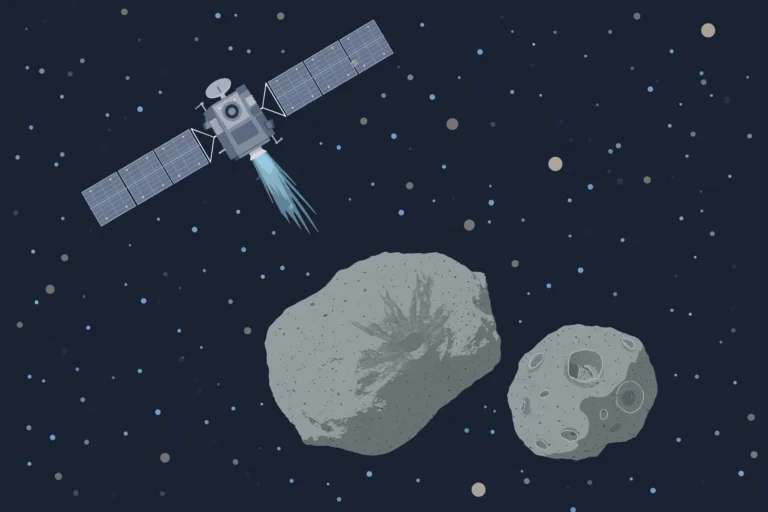
A Japanese spacecraft rocketed toward Mars on Tuesday on an unprecedented quest to explore its mysterious moons and bring back samples.
The Japan Aerospace Exploration Agency launched the mission, known as Martian Moons Exploration or MMX, before dawn from the Tanegashima Space Center, officials said. About an hour later the spacecraft separated from the rocket’s upper stage as planned, and flight controllers burst into applause.

Five of the world’s space agencies joined forces for the five-year mission. The plan is to land a robotic prospector and a rover on Phobos, the larger and closer of Mars’ two small moons. If it succeeds, bits of dust, soil and rock from Phobos will arrive on Earth in 2031, a first for the Martian system.
The $578 million mission carries a French-German rover named Idefix, after the white terrier in the Asterix comics. Phobos is a lumpy, potato-shaped rock about 22 kilometres across, and scientists say studying it could explain how Mars’ moons formed and shed light on the origins of life.
No one has ever landed on Phobos or its sidekick Deimos, and no one has brought samples back from the Martian system. Japan enters the race with an edge, having already completed two asteroid sample-return missions, according to the Associated Press.
Source: Australian Associated Press