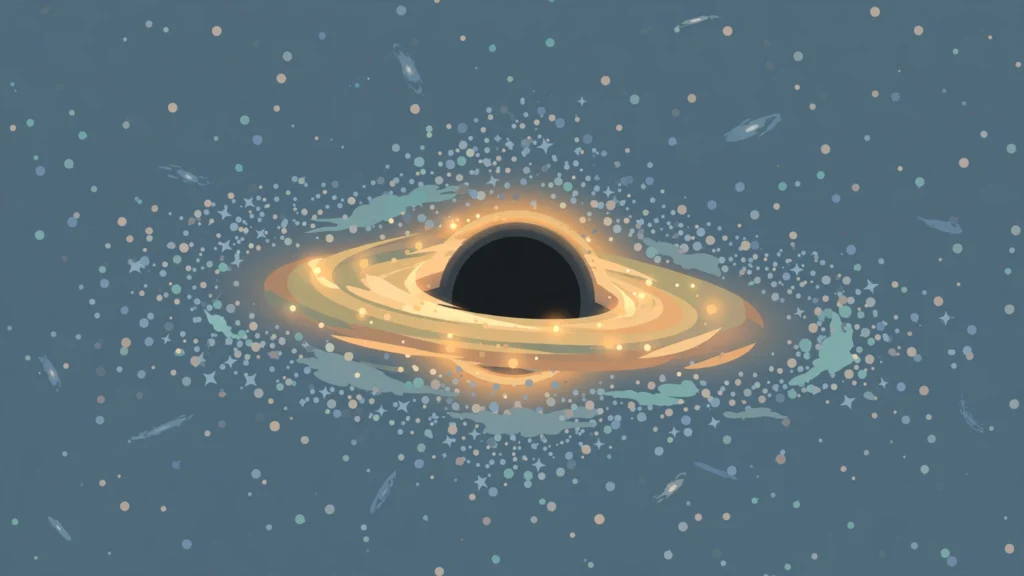
Astronomers using the James Webb Space Telescope have found a possible black hole that outgrew its host galaxy in the early universe, according to a new study.
The black hole sits in MARTA 3887, a clumpy, metal-poor galaxy seen as it was about 12 billion years ago. It weighs roughly 3.3 million times the mass of the sun, while its host galaxy holds only about 145 million solar masses in stars. That puts the black hole at about 2.3 percent of the galaxy’s stellar mass, around 100 times the ratio seen in nearby galaxies.

Mirko Curti of the INAF Astrophysics and Space Science Observatory of Bologna led the team. They combined Webb spectroscopy with Hubble imaging and archival data from the Very Large Telescope’s MUSE instrument. A wide hydrogen-alpha line showed gas moving at about 1,270 kilometres per second. The signal appeared only in hydrogen, not in oxygen lines from calmer gas, which pointed to a black hole rather than an ordinary outflow.
The galaxy itself is compact and low in heavy elements, about 10 percent of the sun’s level, which is typical of a young galaxy. It is forming stars fast, roughly five to nine solar masses of new stars per year, mostly in a recent burst.
The researchers caution that the object is a candidate, not a confirmed black hole. In young, metal-poor galaxies, the spectral signals used to separate black hole activity from star activity can overlap, and extreme stars can mimic an active galactic nucleus. The team used several lines of evidence rather than one to test the case. Their paper is posted on the arXiv preprint server.
Source: Phys.org