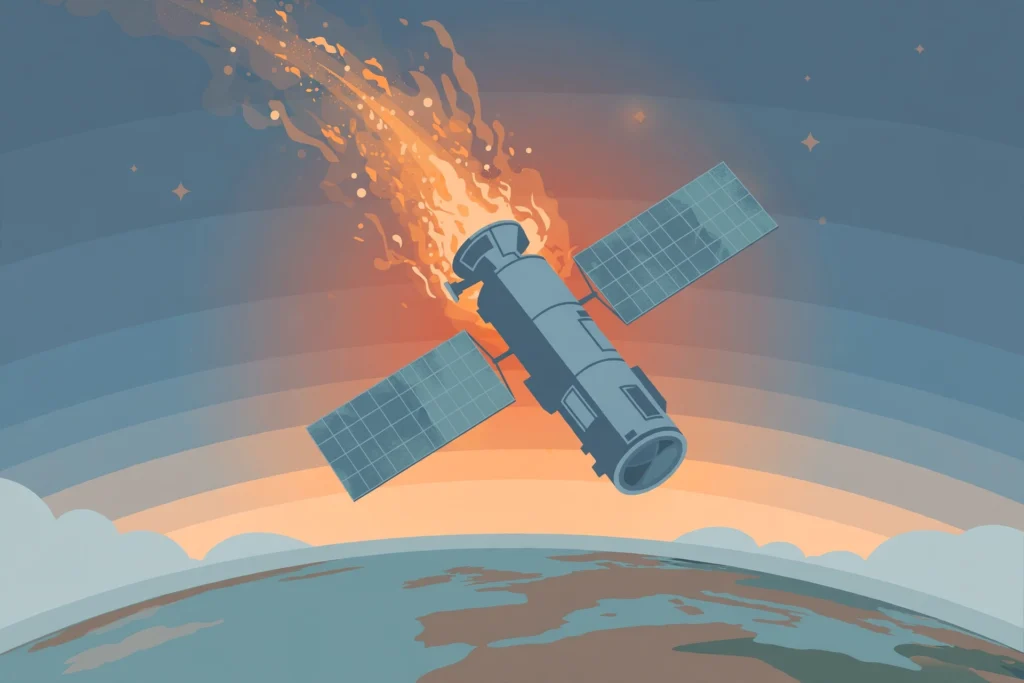
NASA’s Neil Gehrels Swift Observatory is set to fall back to Earth this week, ending a 22-year mission that recorded more than 2,000 gamma-ray bursts and 1,400 exploding stars. The U.S. Space Force forecasts reentry on or around Friday, 6 November, though independent trackers put the window as early as 4 November.
Swift launched on 20 November 2004 to study gamma-ray bursts and supernovas. Intense solar activity in recent years expanded Earth’s upper atmosphere and dragged the 1.5-tonne observatory down from its 600-kilometre orbit to below 275 kilometres, where drag overwhelmed its control systems.
NASA tried to save the telescope through a commercial rescue mission. Arizona-based Katalyst Space launched its robotic Link spacecraft in July, but attitude control problems stopped it 12 to 15 kilometres short of Swift. Link returned to Earth in September, and NASA shut Swift’s systems down in late October after it could no longer hold steady enough for science.
Most of the spacecraft should burn up on reentry. Mission chief scientist Brad Cenko said dense tungsten components and fragments of the telescope’s mirrors could survive the descent. Any surviving debris will most likely land in the ocean, though the reentry zone also covers parts of Africa, Australia, India, Southeast Asia and Central and South America.
Source: SatNews