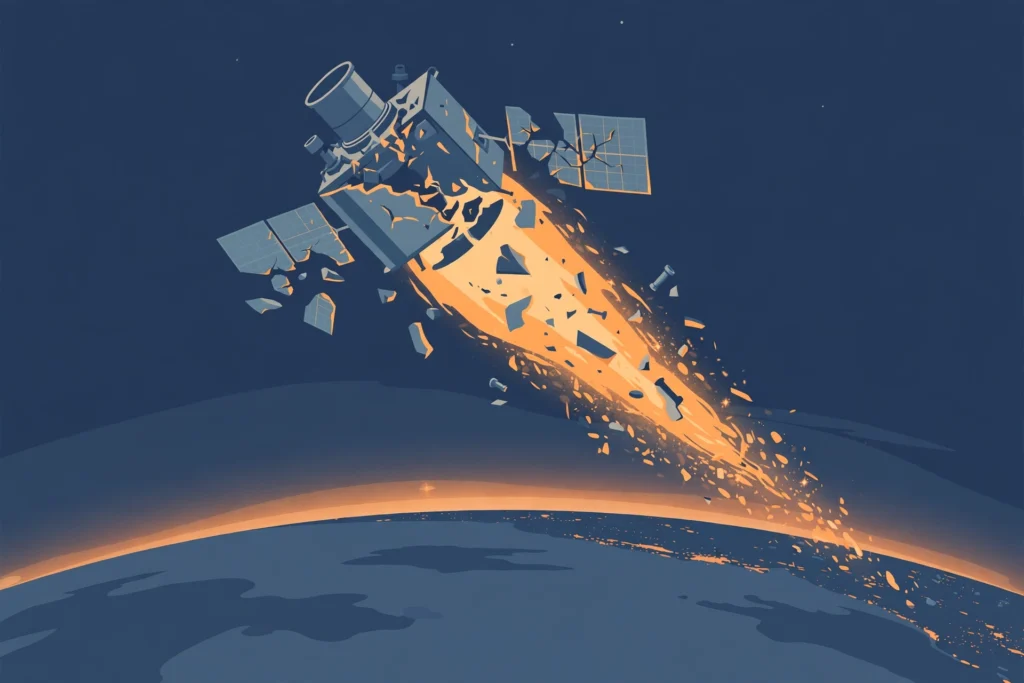
NASA said on Monday that its Swift Observatory should fall back to Earth on Wednesday, November 4, at about 3:30 a.m. EST, with an uncertainty of 11 hours either way. The US Space Force produced the prediction, and NASA put the risk of harm to anyone on the ground at roughly 1 in 2,100.
Most of the roughly 3,200-pound spacecraft should burn up as it crosses the atmosphere, according to NASA. Some parts could survive, including pieces made of tungsten and fragments of its mirrors, mission chief scientist Brad Cenko told CBS News.

Swift launched in November 2004 on a planned two-year mission to study gamma-ray bursts, the most powerful explosions in the universe. It kept working for almost 22 years and detected more than 2,000 of them, according to Popular Science.
The mission nearly got a second life this year. NASA and the private company Katalyst tried to boost Swift into a higher orbit with a robotic spacecraft, but the rescue craft malfunctioned on its way to the observatory and the attempt was abandoned. Swift dropped to about 275 kilometres by October 20, entered safe mode, and its science operations ended.
Any surviving fragments can only land between 20.6 degrees south and 20.6 degrees north latitude, NASA said, a band that covers parts of Africa, Australia, India, Southeast Asia and Central and South America. NASA and the Space Force will keep tracking the descent and updating the prediction as re-entry nears.
Source: NASA